
Think, believe, dream and dare
The concrete possibility of realizing a dream is a conviction that has always been a part of my life, guiding the choices I’ve made. I have navigated difficult times and faced problems that seemed insurmountable, yet I have always sought to live every adventure to the fullest, with passion and tenacity.
I never expected that my curiosity about materials and the joy I find in building things would lead me to art. And, above all, I never imagined where it would all begin.
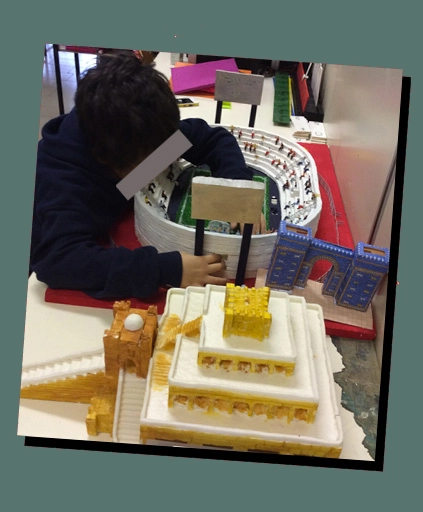
My partner, a special education teacher, was explaining the ziggurat and the Ishtar Gate to her students. There was a blind child in the class. As I listened to her describe her lesson, one question kept coming to mind: how could this child imagine what was being described without being able to see it?
So, I set out to build an answer.
I crafted a ziggurat and an Ishtar Gate out of polystyrene, allowing the child to explore them with his hands—tracing their contours, feeling their volume, and forming a mental image of their shape. The experiment was a success, and it inspired me to go further.
He was a fan of AS Roma, while I supported Lazio. But for once, team loyalties didn’t matter: I built him a model of the Stadio Olimpico, complete with stands, *Subbuteo* players, and even the sound of a stadium announcer reading out the team lineups. He actually attended matches at the stadium to follow Roma; I wanted to bring the physical form of that place into his hands.
He was overjoyed—and for me, that was where it all began.
I asked myself: if I could make a monument or a stadium something that could be explored by touch, could I do the same for a painting? How might blind or visually impaired individuals engage with painting through the sense of touch? And so, I began to reinterpret works by Haring, Matisse, Miró, Mondrian, and other artists in relief. I would cut out sheets of extruded polystyrene using a heated wire, paint the individual elements with acrylics, and glue them onto canvas. The shapes gained depth, stood out in space, and became paths to be traced with one’s fingers.
At my first exhibition, the paintings were not just for looking at—they could, and indeed *should*, be touched. I invited people to close their eyes, explore the works with their hands, and try to recognize the shapes. The very gesture one usually avoids when standing before a painting became the starting point for engaging with the work.
I did not claim to convey everything an image tells through touch alone. Rather, I wanted to offer an additional possibility: to get closer to the forms, discover the relationships between them, and construct one’s own personal image.
Since that first experience, my exploration has continued. Alongside these reinterpretations, I felt the need to give form to my own ideas, seeking out the most suitable materials and techniques each time. To the polystyrene, I added wood, one-dollar bills, iron, and jute. Cutting, layering, and assembling became different ways for me to express myself, to break away from conventional patterns, and to transform an intuition into something concrete and tangible.
I didn’t set out with the intention of becoming an artist. I began with a question—a desire to build something for a child. It was the act of making—one piece after another—that brought me to where I am today.
Now, I hope that anyone who encounters my work might feel an emotion, pause out of curiosity, and discover something that resonates with them personally. And I hope that, while standing before one of my works, I might also be able to share the emotions that accompanied me as I created it.
I owe everything to him, and I do not forget it. Every time I create a work, my thoughts return to that child: it was with him that everything began, and his presence continues to accompany me in every new creation.
I feel alive the moment I have an idea, happy while I am bringing it to life, and at peace once I have finished.
Download my artist dossier (PDF) to read my full biography and view a selection of my work.